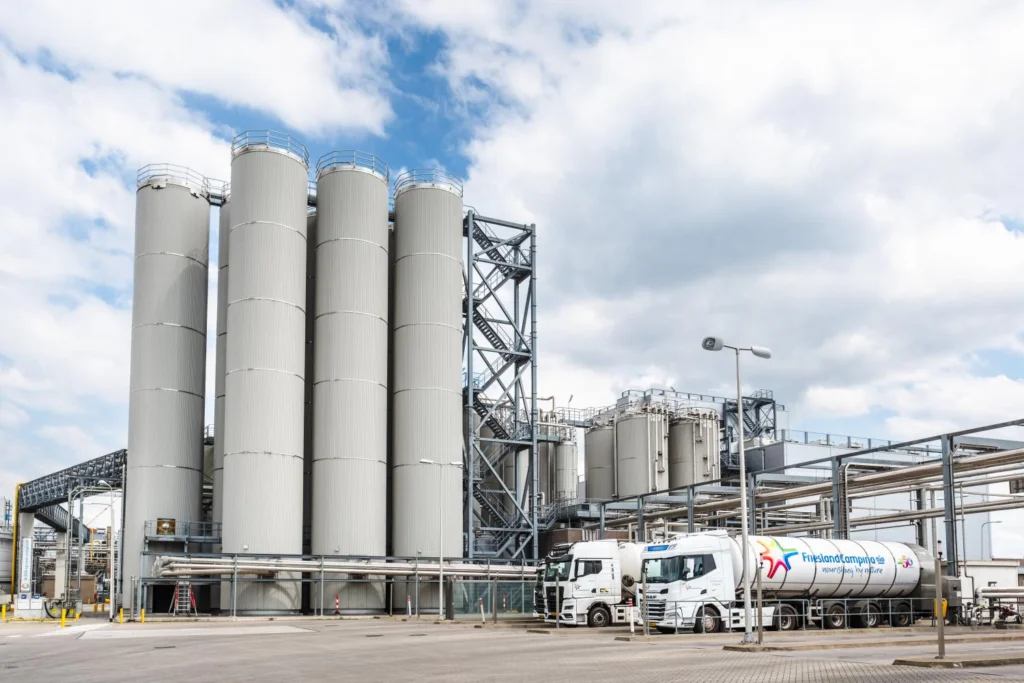
Interview with FrieslandCampina directors Sanne Griffioen-Roose (Director Farm Sustainability) and Harrie van Echteld (Technology Director)
“I believe that the world can change for the better, and that companies play an important role in this,” says Sanne Griffioen-Roose, Director Farm Sustainability at FrieslandCampina. Her colleague Harrie van Echteld, Technology Director Global Supply Chain, shares the same vision. Despite their different roles, both leaders work daily on the sustainability strategy from grass to glass, with which FrieslandCampina covers the entire chain. On September 25, Sanne and Harrie invite the SINN network to visit farm De Elihoeve, where they will show how FrieslandCampina is working on future-proof business operations during an exclusive Vision Dinner.
In this interview, we speak with Sanne and Harrie about their leadership and motivation to drive sustainability within FrieslandCampina. How are the 14,634 member dairy farmers in the Netherlands, Belgium and Germany involved? What role does technology play? And what do they see as the biggest challenges for the future? Read the interview for inspiration and insights that can help your organization with the next sustainable step.
About Sanne
Sanne has a background in science. She obtained her PhD at the Department of Human Nutrition of Wageningen University. After that, she continued to do research there into nutrition and behavior. Eleven years ago, she switched to FrieslandCampina: a great opportunity to gain experience in the business world. Sanne sees herself as an idealist: “The business world offers enormous potential to make an impact.”
Within FrieslandCampina, she grew from R&D roles to positions that focus on sustainability. Her motivation to bring about change from within grew steadily. Partly through leadership programs, she developed into a driving force behind the strategic course.
Since 2022, as Director Farm Sustainability, she has been responsible for making dairy farming more sustainable. This is essential, because almost half of FrieslandCampina’s impact on climate and nature takes place on the farmyard. “Making farming more sustainable is no easy task,” says Sanne, “but because there is so much potential to make a positive impact, I do this work with conviction.”
About Harrie
Harrie has been working at FrieslandCampina for 21 years. After studying mechanical engineering in Eindhoven, he started as a technical manager and moved to FrieslandCampina in 2003. “I have had many different roles, but they always revolve around building, innovating and optimizing the supply chain.” Since 2023, he has been Technology Director of the Global Supply Chain.
Like Sanne, Harrie has a strong connection with dairy farming: he grew up on a farm, now run by his brother. “That’s why I understand the farmers well,” he says. That empathy is important. As a cooperative, the farmers are co-owners and have a lot of influence on the strategy.
Why has Harrie been committed to FrieslandCampina for 21 years? “Because we make honest products at an honest company. We realize that production has an impact, but we don’t hide that.” In addition, he notices that everyone within the company can exert influence. “From my role, I can make a very concrete contribution to sustainability. We are increasingly aware of where the greatest emissions are. In this way, we all contribute to the strategy from grass to glass.”
“You Have to Do the Right Things”
When Sanne talks about sustainability, she doesn’t start with green pictures, but with the Sustainable Development Goals. “These form a blueprint to end poverty, protect the planet and ensure prosperity and peace.” The core activity of FrieslandCampina – producing dairy – is directly related to this: “Dairy contains essential nutrients for people’s health.”
At the same time, Sanne is aware of the impact of dairy production: “We take our responsibility and work daily to reduce it.” Sustainability requires leadership. “It’s about making the right decisions at the right time. Life is not always easy, but that’s okay too.”
Making Sustainability more Sustainable Together with the Farmers
FrieslandCampina is not only working on sustainability – the farmers are co-owners of the company. “So we can’t impose anything on them,” says Harrie. “Although farmers sometimes get negative news, many are actively involved in nature management.” They know that their future depends on a good balance with nature.
Sanne emphasizes the power of the cooperative structure: there are annual meetings and a main committee that influences daily operations. “The cooperative and the company work as one – also in the field of sustainability.”
The course is determined through open dialogue. “You can’t just put the burden on the farmer. As a company, we must ALSO make choices in our business operations to make sustainability financially possible.”
Technology and Sustainability
As technology director, Harrie partly decides how resources are used. “It is a balance between what is technically possible, the availability of electricity and resources.” FrieslandCampina is increasingly monitoring the energy consumption of equipment in factories to prevent waste.
Energy saving goes hand in hand with efficiency. “Losing a liter of milk because a package tears during production is a waste,” says Harrie. That is why efforts are also being made to improve general processes.
Technology plays a major role in this: new separation and preservation techniques, digitization, and smart planning systems. FrieslandCampina applies technologies from the market within the dairy chain. “We do our own research, but mainly develop smart applications for our sector.”
The Biggest Challenges for the Future
For Sanne, the biggest challenge lies in biodiversity. “Climate is now on the map for companies, but how do we get that same flywheel going for biodiversity?” FrieslandCampina is already working on projects such as herb-rich grassland, but it is not yet enough. “We need business models that enable companies to innovate sustainably.”
Harrie sees the biggest challenge elsewhere: the availability of dairy and food in Africa and Asia. “Food must be affordable there, because it is precisely THERE that it is essential for public health.” At the same time, packaging material must be limited. “We must ensure that our products can go there without unnecessary packaging, which then has to be processed.”
Flevum Vision Dinner at the Visiting Farm
On September 25, Sanne and Harrie will welcome the network to De Elihoeve in Snelrewaard, FrieslandCampina’s show farm. During this evening, they will discuss sustainability, technology and supply chain. The farmer shows his work and gives participants a unique insight into the practice of FrieslandCampina.
Author: Sanne Vos-Zwart